

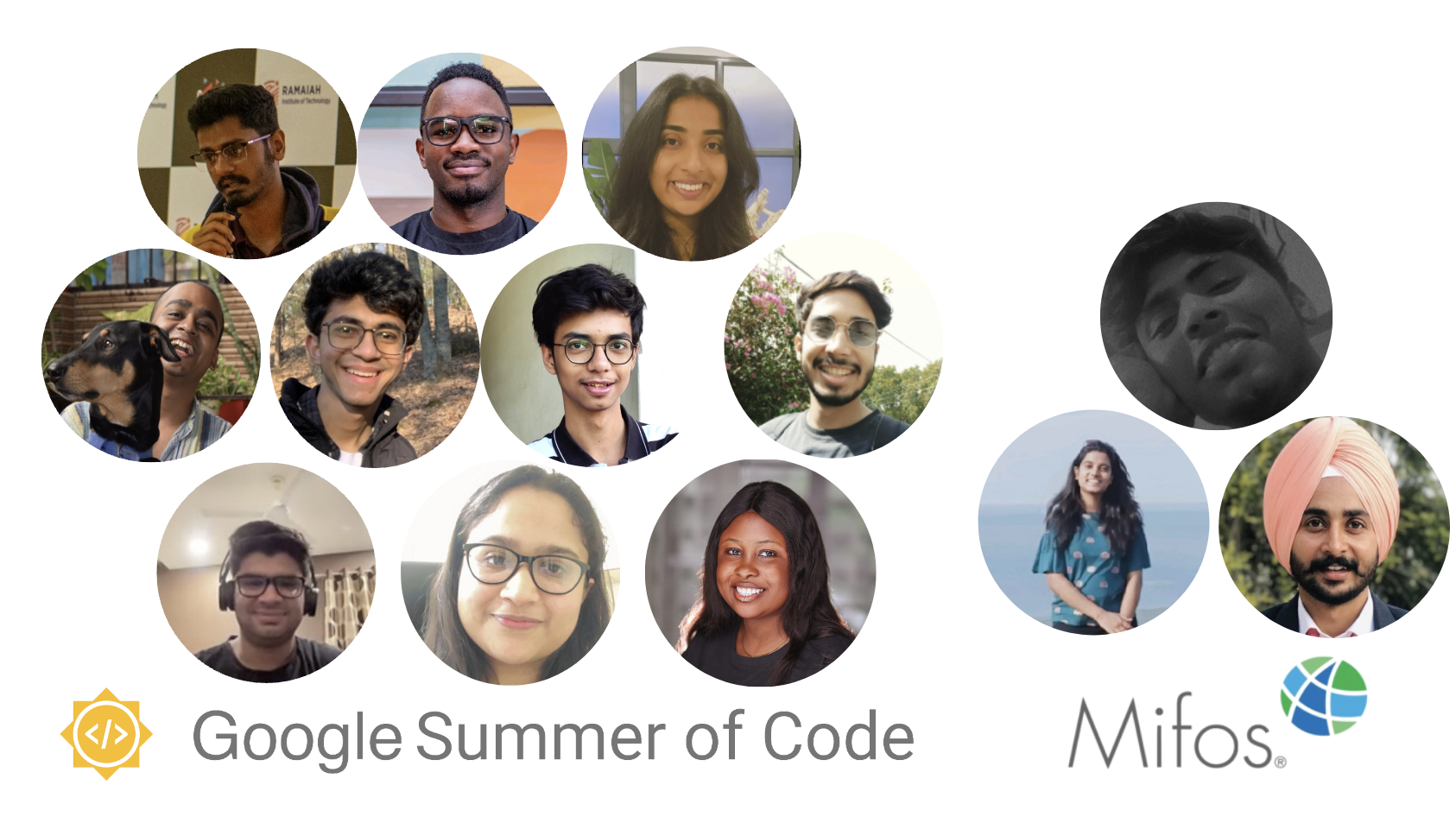
Join us in officially welcoming our class of interns for 2024. We have the pleasure of working with 18 interns across Google Summer of Code and Code for GovTech. This year Google of Summer of Code is celebrating its 20th year and marks our 12th year of participation overall and 9th year directly as the Mifos Initiative with eleven interns chosen. We are participating for the first time in the Code for GovTech Dedicated Mentoring Program which is now entering its third year being led by Samagra Governance. We have been able to select seven interns through this program which aims to cultivate a community of coders that can build and contribute to global Digital Public Goods. We are blessed to once again be working with the cream of the crop of burgeoning open source contributors as we had to be highly selective in choosing our eleven interns for GSOC amongst more than sixty applicants and our seven C4GT interns from dozens of applicants as well. This year we have 16 contributors from India and for the first time, two contributors from Egypt.
While our ultimate aim is build the next generation of open source contributors and lay the bedrock and foundation for the future of our community with new maintainers and committers, as usual, the projects proposed by our mentors and applied to by our interns will add immense value across all of our codebases and projects.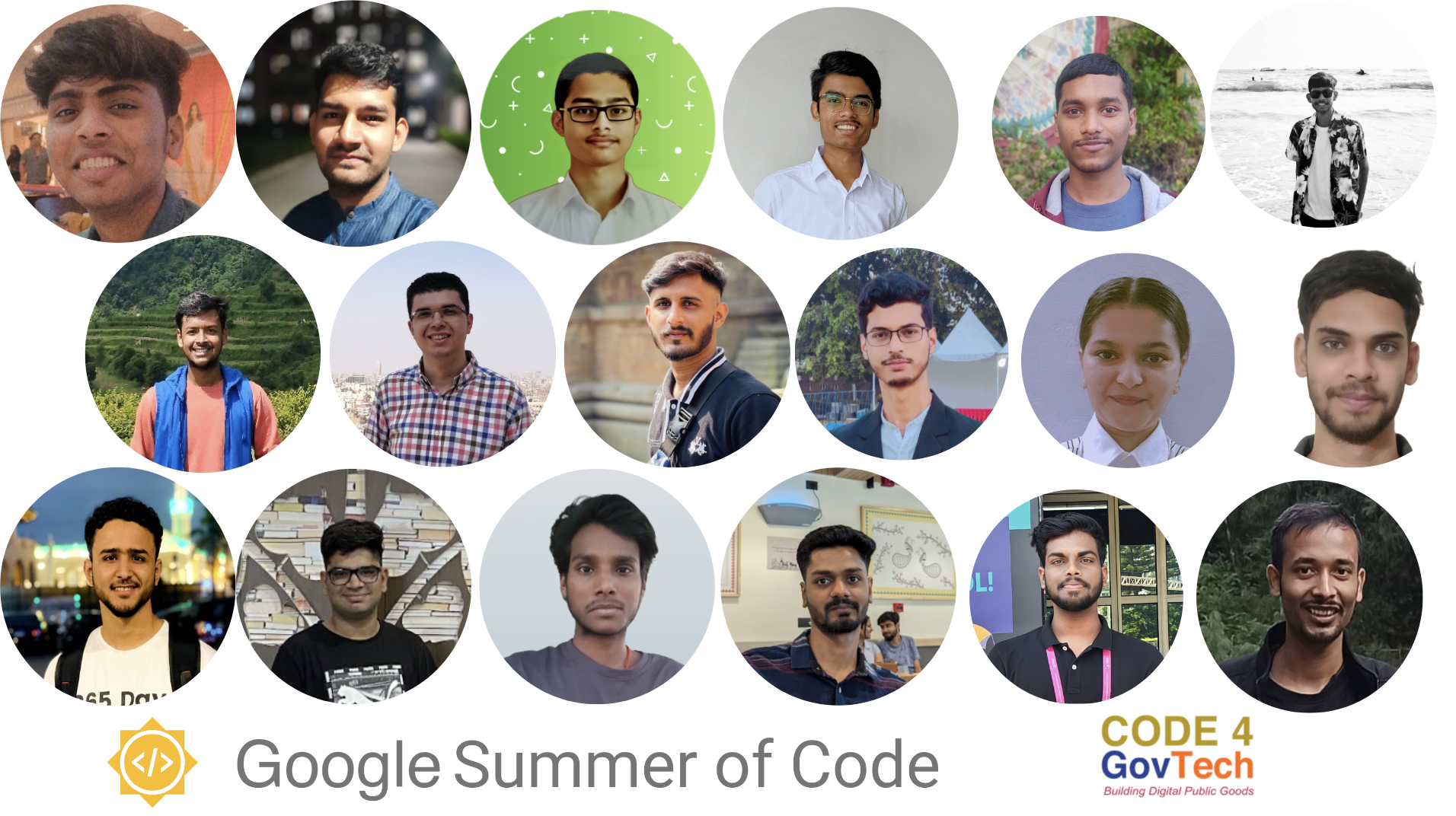
For Google Summer of Code, we will have four interns working on mobile development, three interns on web and front-end development, three interns on artificial intelligence and machine learning related projects, and one on the Apache Fineract platform.
On the mobile front, our interns will be primarily focused on cross-cutting changes across the various applications to upgrade core dependencies, migrate to Jetpack Compose, evolve towards multimodal architectures, enable cross-platform development through Kotlin Multiplatform and consume common layers like our UI library, SDK, and soon-to-be-developed self-service middleware layer. In addition we will refine the overall user experience and deepen payment integration support especially for use cases like G2P. Rajan Maurya leads our team of mentors including Avinash Vijayvargiya, Chirag Gupta who will be guiding our mobile interns. Pratyush Singh and Aditya Kumdale will be heading up efforts to improve our mobile wallet, specifically for G2P use cases, Avneet Singh will be championing efforts around our Mifos Mobile mobile banking app and Aditya Gupta working on our Android Client and SDK.
On the web development front our team of mentors include Jose Alberto Hernandez, Bharath Gowda, and previous interns, Ramveer Singh and Radha Thakare. Pushpendra Singh and Vikash Prem Sharma will be focused on and designing and implementing a micro frontend proof of concept to the improve the scalability, maintainability and ease of developing new user experiences while Omar Nabile will lead efforts to continue enhancing our web app for greater performance and a better user experience.
This year we have a deeper focus on AI with multiple projects including Parth Kaushal continuing to refine and enhance the accuracy of our machine learning credit scorecard module under the mentorship of Victor Romero and Nasser, Akshat Sharma working on a brand new bank statement analysis module for creditworthiness led by Jeremy Engelbrecht, and Shubham Pal under the leadership of David Higgins and Chaitanya Nuthalapati exploring the power of generative AI to create a chatbot and self-support mechanism to help users and implementers better access our documentation and lessons learned over all the years. Last but not least, Zeyad Nasef, will be helping to improve the maintainability and overall code quality of Fineract by introducing type-safety at the REST API layer under the mentorship of Aleks Vidakovic and Sanyam and Rahul Goel.
For Code for GovTech, we have a diverse array of projects all related to our emerging digital public goods to fuel digital public infrastructure that advances the adoption of instant inclusive payment systems and enables effective last-mile G2P distribution. Tom Daly leads our team of mentors including Elijah Okello, Courage Angeh, Nelly Kiboi, and Victor Romero stewarding several projects related to DevOps and deployability of our DPGs. These projects include Abhinav Kumar working on our next iteration of Mojafos, DPI as a Service, streamlining the deployment of Mifos/Fineract, Payment Hub EE and Mojaloop. Yash Sharma will be working on Implementing a Kubernetes Operator for Mifos X/Fineract to improve its deployment and Devesh Pandey will be working on a performance testing tool for Mifos Payment Hub EE.
On the mobile front, we have two projects: enhancements to our mobile wallet led by Akash Meruva under the mentorship of Rajan Maurya and Avinaash Vijayvargiya and Palak Meshra working on the next version of our PISP/3PPI/Open Banking Fintech App being mentored by Karim Jindani along with Azeem Yaseen and Tifail Gadit.
Ratnesh Mishra will be spearheading efforts around evolving our Mojaloop Connector in PH-EE to work with Mojaloop vNext. He is mentored by Elijah Okello alongside Tom Daly, Nelly Kiboi, Victor Romero and Courage Angeh. Dipan Dhali rounds out our C4GT projects focusing on the front-end with continued enhancements to our Operations Web app for Payment Hub EE under the stewardship of Alberto Hernandez, Karim Jindani, Azeem Yaseen and Tufail Gadit.
Thank you once again to Google for selecting us to participate in Summer of Code and for Samagra Governance for its leadership of the C4GT program. Thank you to all the mentors for all their guidance so far and continuing to lead our interns throughout the summer.
Please join us at our Town Hall Meeting this Friday June 21 at 1530 GMT via Zoom where we will formally introduce all our interns.
Pratyush Singh – India
|
Aditya Kumdale – India
|
Avneet Singh – India
|
Aditya Gupta – India
|
Pushpendra Kumar – India
|
Omar Nabil – Egypt
|
Vikash Prem Sharma – India –
|
|
Parth Kaushal – India
|
Shubham Pal – India
|
Akshat Sharma – India
|
Zeyad Nasef – Egypt
|
Abhinav Kumar – India
|
Dipan Dhali – India
|
Yash Sharma – India
|
Palak Mishra – India
|
Akash Meruva – India
|
Devesh Pandey – India
|
Ratnesh Mishra – India
|
|
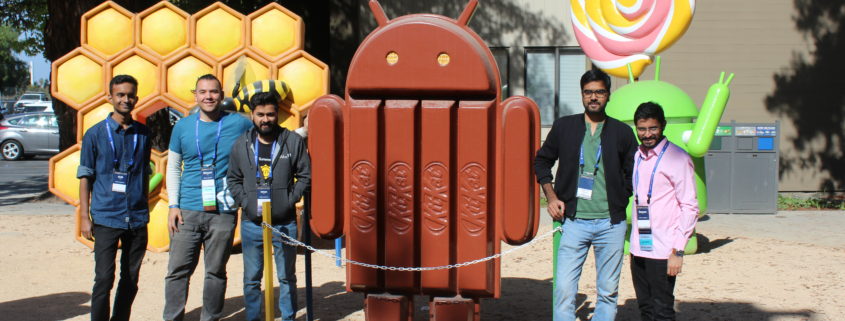
 This summer you’ll have the ability to change lives – three billion of them – one line of code at a time. The Mifos Initiative will be participating in Google Summer of Code for the twelfth time. Last year we had the honor and privilege of stewarding 14 interns in total – ten through Google Summer of Code and four through our inaugural Mifos Summer of Code. Interns will not only have the opportunity to contribute to our social mission but also be able to work on cutting edge technologies being used by our ever-growing global community and ecosystem of fintechs and financial inclusion providers. Interns will be shaped by the open source experience led by our intrepid mentors, rewarded by our mission of fighting poverty with financial inclusion, and growing their professional skillset and experience to position themselves for future careers or entrepreneurial endeavors in fintech.
Google Summer of Code is a global, online program sponsored by Google focused on bringing new contributors into open source software development. Interns accepted to the program will spend their summers coding from May 27th to August 26th and upon successful evaluations, receive a stipend provided by Google. For full details on GSoC, read the FAQ and browse the program timeline – applications are open from March 18 through April 2! You can apply from our organization page.
To help aspiring applicants and answer any questions related to ideas or improving your applications and proposal, we’ll be holding a Mifos Google Summer of Code AMA (Ask Me Anything) on Thursday March 7 at 1500 GMT via Zoom Webinar .
You’ll have the have the chance to build web and mobile apps for digital financial services, contribute to our award-winning Mifos X open source technology platform powered by Apache Fineract, extend our modern payment orchestration engine, Payment Hub EE, enhance our Digital Public Goods for use cases like G2P, and pioneer innovative uses of Generative AI for advancing financial health.
As the scope of our digital public goods and breath of use cases of fintech adoption continue to grow, so does the variety of projects and technologies we have available for interns to contribute to. Once again we’ll be continuing to refine our suite of web and mobile apps for customers and staff – with a deep focus this year on cross-cutting tools to streamline the developer experience including extension of our auto-generated clients and SDKs. We will have a variety of projects on or around the Apache Fineract platform for back-end and full stack developers including core contributions and refactoring, new module development and integration. On the payments front, as Payment Hub EE gets deployed for more uses cases ranging from mobile money to instant inclusive payment systems to G2P, we’re looking to enhance deployability, ease of configuration, and performance to drive more adoption. Mifos has continued to establish a deeper presence as a catalytic digital public good for managing accounts, orchestrating payments and enabling digital payment adoption so we’ll have a growing number of DPG/DPI and Govtech related projects for Payment Hub EE and integration with other DPGs for use cases like digitizing cash-based social protection programs.
This year we’ll also have a deeper focus on AI projects as part of Mifos AI for All and Data Science for Good Initiative. AI can have transformative potential for financial inclusion and we are only starting to scratch the surface of what can be achieved. We look to expand our existing projects for credit scoring and chatbots with several new projects using generative AI and LLM and LAMs to improve customer support, design better products, better analyze risk, mprove the developer experience, detect and prevent fraud and more.
Want to learn more? Browse our ideas page for projects and links to all our code repositories.
We’re pleased to be the recipient of this research grant from the Interledger Foundation that will hopefully be the start of an active collaboration between the Mifos and Interledger communities and ecosystems to advance inclusive financial services for all. Check out the Interledger Foundation website for a link to the original announcement.
Through the Interledger Foundation Research Grant, Mifos will explore how the Interledger Protocol (ILP) can be part of Digital Public Infrastructure and contribute to democratizing financial services through its open protocol suite for sending payments across different ledgers.
 Mifos has pioneered open-source banking technology for the past fifteen years, transforming the entire sector at each major stage of evolution from microfinance to financial inclusion to digital financial services. They were chosen as an MIT Solver for the 2021 Digital Inclusion Global Challenge and awarded the 2021 and 2022 Banking Tech Awards for Best Contribution to Economic Mobility in Banking & Finance.
Their building blocks for banking are recognized as digital public goods within digital public infrastructure to achieve the UN SDG of no poverty. Through making a core banking commoditized infrastructure, any organization can embed any financial service to any customer via any channel.
Briana Marbury, president and CEO of Interledger Foundation, says, “We are delighted to work with Mifos to support their mission of advancing the financial health of the underbanked and further digital financial inclusion efforts as a whole.“
Mifos is working with BaaSFlow, GH Solutions Consultants, and Brook IT Consulting to undertake this research with the goal of identifying the next steps for ensuring that Interledger is a part of Digital Public Infrastructure considerations for implementers. Their research will bring together a range of stakeholders and experts in ILP, Digital Public Goods, G2P payments, and in-country experts to understand how this can be achieved and barriers to adoption that need to be overcome. Their research will be made available through open communities and contribute to Interledger Foundation’s Mission to build equity and inclusion within a global interoperable payments network.
President and CEO of Mifos, Ed Cable, says, “As a mission-driven organization, we are excited to explore the possibilities of the Interledger Protocol (ILP) as a building block within our growing ecosystem to improve people’s lives through access to financial services.”
BaaSFlow brings to the project its expertise in architecting and contributing to digital public goods. “We’re looking forward to exploring how the Interledger Protocol and the Open Payments concept can be applied to Digital Public Infrastructure thinking in the context of Digital Public Goods like Mifos, Fineract, and G2P payments”, states BaaSFlow’s CEO James Dailey.
If you are interested in contributing to Mifos research, you can contact dpi@mifos.org and stay up to date with their research through 2024 here: community.interledger.org
About Mifos:
The Mifos Initiative is a global 501(c)3 fintech non-profit leveraging the cloud, mobile & open source community to democratize financial services worldwide and digitally transform the world’s 3 billion poor and underbanked. Our mission is to scale the development and impact of inclusive fintech through an open community to advance the financial health of these 3 billion underbanked.
Our building blocks for banking, recognized as digital public goods, make core banking commoditized infrastructure, empowering any organization, anywhere to embed any financial service to any customer via any channel. We provide the common functionalities for creating customers, managing wallets, savings and loan accounts, orchestrating payments, and maintaining the financial ledger & reports.
In 2023 Mifos & Fineract demonstrated massive scalability for the public & private sector. In 2024, we will be a catalytic force for digital public infrastructure.
.
 We are excited to formally announce the newest member of our Board of Directors, Min Tha Gyaw. Min is a global leader in inclusive fintech with more than two decades of experience in banking and payments culminating in his current role as Chief Strategy Officer for ThitsaWorks. Min will be a critical part of positioning the digital public goods maintained by Mifos to accelerate the impact of instant inclusive payment systems globally and the adoption of digital public infrastructure to advance universal financial health. His keen vision across digital financial services, his proven ability to execute, and his highly respected perspective in the ecosystem will unlock new opportunities for collaboration, sustainability, and innovation for initiative.
Here’s a bit more on Min in his own words:
Min brings more than 18 years of experience in payments, core banking, credit analytics systems, as well as expertise in banking and investments. He currently serves as the Chief Strategy Officer of ThitsaWorks, a Singapore-based technology firm, where he oversees the firm’s partnerships and successful expansion into Latin America, the Caribbean, and key African markets. Min is a member of the Mojaloop Community Council, and he also leads ThitsaWorks’ engagement and contributions to the Mifos Initiative, Interledger Protocol, and other Digital Public Goods initiatives.
Before joining ThitsaWorks, Min held several senior management positions with leading commercial banks in Myanmar, spearheading numerous strategic initiatives to introduce innovative products and solutions. A strong advocate for financial inclusion, Min leveraged his banking expertise to pioneer lending to Microfinance Institutions (MFIs) in Myanmar, in collaboration with multiple international Development Finance Institutions (DFIs). Min received his MBA from the University of Chicago Booth School of Business, a Graduate Certificate from Johns Hopkins University (SAIS), and a B.A. in Economics from Beloit College.
We have already been collaborating closely with Min in the past and are eager to have him as part of the Board to impart his deep wisdom and strong connections by assisting in the following areas:
Please help in welcoming Min to the Mifos Community as a board member! We are extremely grateful for his time dedicated to our initiative and community!

This regular blog series will showcase partners and the innovative solutions they’ve built that are powered by the Apache Fineract and Mifos X platforms. These case studies will demonstrate your solution to end users who are seeking to use them as well as show other partners in the community how they too can leverage the Apache Fineract platform to build their own solutions powered by an open source core banking infrastructure.
Advancly: Powering Progress
According to the World Bank, formal MSMEs in sub-Saharan Africa face a huge finance gap of $331 billion (USD). This is largely because they are unable to provide key information about their businesses to traditional/corporate lenders. But financing is key to the survival of these businesses who, beyond accounting for 60% of jobs in Africa, are representative of the dreams and aspirations of entrepreneurs and many times key to the survival of them and their families.
For the most part, MSME financial requirements are too large for microfinance banks but too small to be effectively served by corporate bank models. This leaves a “missing middle” in the need of the right financing options, with financial need that stands at over 1.6 trillion USD (formal and informal SMEs).
Advancly exists to bridge the lending gap for the missing middle. We provide businesses across Africa and emerging markets with debt capital and embedded finance services, enabling them to utilise credit to grow and scale. Through technology, we harness data that provides a backdrop for intelligent and automated credit risk assessment. By adopting machine learning and artificial intelligence that allows for a robust credit-scoring, we work to ensure that our non-performing loans remain lower than industry realities.
Advancly is powered by a team of analytic, strategic and creative thinkers who work daily to build human-centred credit solutions. We are enabling entrepreneurs and founders to succeed at building their economies by building their dreams.
Our ethos is backed by our belief that, when businesses progress, society progresses. For us, progress simply means “better”. It is the daily efforts put in to create a positively different reality. It is when a business can serve one more customer and sell one more product. It is when an entrepreneur moves one step closer to building the business of their dreams.
CEO Profile
Lotanna Julian is the CEO and co-founder of Advancly. With an astute background in finance, strategy, operations and investment portfolio management, Lotanna leads Advancly’s skilled team in their mission to Power Progress for MSME’s across Africa and emerging markets by innovating access to credit through capital, data and technology.
Lotanna has a vast experience in global business operations and investment portfolio management, which have proven invaluable in the Advancly journey and grown the company in record time. Lotanna and the Advancly team are looking to take the business to 10 countries by 2026 – with the goal of injecting $500m into MSMEs across Africa and emerging markets.
 We are pleased to recognize Victor Romero as the Mifos Star Contributor in this July 2023 edition of Star Contributor of the Month. Victor has been a long-time member of the Mifos community, serving in many different roles throughout the years such as being a mentor for Google Summer of Code and Apache Fineract committer, and we are thankful to him for his tireless efforts to help create a world of 3 billion Maries. We appreciate the hard work and passion that Victor brings to our community, and we are excited to see what he has in store for the future. Words can’t capture how valuable Victor has been to the community – he embodies what an active contributor should do as he never hesitates to share his knowledge or make his skills available to assist the community. While not all of his contributions are publicly visible, I can’t count the numerous calls or meetings Victor has joined to share requirements, guide an intern or spearhead a project. No matter the ask, Victor always steps up to help the community and with any project or successful milestone he or his team has, he’s ready to share those lessons learned.

Our 2023 intern programs are well underway and our interns are making great progress. Google Summer of Code is now in its 18th year and Mifos has the privilege of participating for the 8th time independently and 11th year overall. Once again we were blessed with the selection of 10 interns through Google Summer of Code. However we had such a high-quality number of applicants yet a limited number of slots to select them for GSOC that we have also offered an additional 4 internships separately through our inaugural Mifos Summer of Code. So give a big welcome to all 14 of our interns who will be contributing this summer and to all of their mentors who have been guiding them on their journeys. We will be sending regular updates to the mailing list on progress and hosting mid-term and end of program showcases to keep the community informed of their work.
While our primary aim for Summer of Code is to build the next generation of open source contributors who will become the future maintainers, committers, and builders across our ecosystem, the projects this year will be quite impactful for the community with valuable enhancements to our existing projects as well as new exploratory work. Between Google Summer of Code and Mifos Summer of Code, we’ll have five interns working on our mobile apps, 2 interns working on the web front-end, 2 working on security and penetration testing, 2 on the Fineract platform or DevOps, and 3 AI-related projects.
On the front-end, Pushpendra Kumar will be enhancing the new Web App to consume the auto-generated typescript client to be more maintainable and synchronized with Fineract releases while Radha Thakare will explore the next generation of our web UI by building out a POC of a modular UI framework containing micro-front-ends.
All of our mobile apps will be getting some attention with Pratyush Singh and Abhishek Gururani working across Mifos Mobile our mobile banking app to refine its architecture, upgrade its libraries, improve the security of its connection to the Fineract back-end and extend its consumption of the mobile UI library and Android SDK. The mobile wallet will be getting similar treatment from Rachit Gupta with upgrading of dependencies, streamlining of the UI with the mobile UI library and genericizing the use cases it supports for a mobile wallet that represents that majority of global wallet use cases. Aditya Gupta will be enhancing the Android Client for field officers to further consume more of the Android SDK and complete its migration from Java to Kotlin. Lakhwinder will be splitting his time between the mobile UI library but also completing our open banking fintech app and extending it to integrate with the Mojaloop PISP APIs for third party fintech innovation.
On the back-end Fineract platform, Abhinav will be leveraging his experience in converting monolithic apps to microservices architectures by enabling greater Fineract modularity by extending the customer module layer designed by Aleks Vidakovic across more packages in Fineract. On the DevOps front, Elijah Okello, will be helping to demonstrate the power of Mifos, Mojaloop and Payment Hub EE by providing an easily deployable package along with demonstrate storyboards and use cases to showcase the power of IIPS powered by DPGs. Both Kerlyn Manyi and Yash Sancheti have extensive experience with cyber security and penetration testing and will be putting Fineract as well as the Mifos web and mobile apps through rigorous security, penetration testing, and static analysis under the mentorship of Godfrey Kutumela. Meghna Bajoria, with support from Jeremy Engelbrecht, will be resurrecting our Mifos Chatbot for Fineract to take advantage of the latest advances in AI and LLM. As part of Mifos Summer of Code, both Deepthi M and A Patel as medium-duration projects will be working our Vision PPI app to make the app itself functional and refine the cloud vision analytics for image processing for PPI scorecards.
Pratyush Singh – India
|
Abhishek Gurarani – India
|
Rachit Gupta – USA
|
Pushpendra Kumar – India
|
Radha Thakare – India
|
|
Abhinav Sinha – USA
|
Elijah Okello – Uganda
|
Meghna Bajoria -USA
|
Kerlyn Manyi – Cameroon
|
Yash Sancheti – India
|
Deepthi Mavillapally- India
|
A Patel – India
|
Aditya Gupta – India
|
Lakhwinder Singh Sarao – India
|
The Mifos Initiative is honored to have our Payment Hub Enterprise Edition (PH-EE) chosen by Fintech Futures as the Winner of the 2022 Banking Tech Award for Best Contribution to Economic Mobility in Banking & Finance. Awards were given out earlier this December at the 23rd annual Banking Tech Awards hosted by Fintech Futures at the Royal Lancaster Hotel in London.
It is as honor to have been selected from an impressive class of finalists including:
This award recognizes projects using fintech/banking tech to champion financial inclusion and economic mobility. Examples include products/services for the underbanked communities and areas; products and services for specific demographics that are often overlooked, such as children and pensioners; innovative salary and benefits management tools; increasing financial literacy; promoting financial health etc.

This award builds off of our recognition in 2021 of Mifos X as the recipient of this same award as a catalyst for innovation by providing a core banking & account management platform delivered as open source building blocks to manage the store of value to embed financial services anywhere. For 2022, Mifos has now been recognized for our complementary open source payment orchestration engine, Mifos Payment Hub EE (PH-EE), which facilitates the movement of value by enabling institutions to seamlessly connect to any digital payment rail & enable the participation of the 3B underbanked in the digital economy. Payments are the gateway to financial inclusion with the means of transacting digitally as that first step towards financial health.
Mifos X, a catalytic foundation to manage wallets & accounts in the cloud is now coupled with Mifos Payment Hub EE, providing the capability for the entire industry to connect to digital rails including:
Payment Hub EE provides a highly scalable and extensible means to enable any institution to participate in a digital payment system regardless of size by:
Payment Hub EE is now being actively deployed for a variety of use case across the globe including:
Learn more about Payment Hub EE at https://payments.mifos.org.
You can view a list of all the winners and finalists.

The Banking Tech Awards recognise excellence and innovation in the use of IT in financial services worldwide, and the people who make it happen. 2022 was the 23rd year for these prestigious awards.
For banks and financial institutions, winning a Banking Tech Award showcases the value of their technology investments and showcases their skills, commitment, creativity and execution.
For software providers, a Banking Tech Award is a valuable recognition of the company’s products and services.
For individuals and teams, a Banking Tech Award is a prized acknowledgement of their skills, leadership, vision, inspiration and dedication to the industry’s betterment.
The 2022 awards ceremony took place on 1st December 2022 at the Royal Lancaster Hotel, London.
The Banking Tech Awards are owned and produced by FinTech Futures, the definitive source of news and analysis of the global fintech sector.
